


Green, orange and red. These three colours have set the rhythm of our daily lives since 15 June, the date on which Belgians were once again allowed to travel beyond the country's borders. The Covid-19 pandemic is still with us, but it is not holding back holiday departures far from home. Indeed, it is perfectly possible to travel abroad, though certain measures must be observed in order to prepare your trip as effectively as possible.
Are you off to Spain soon? Feeling lost in the flood of daily information? In this new article, we take stock to help you prepare your trip with complete peace of mind.
The situation in the Iberian Peninsula
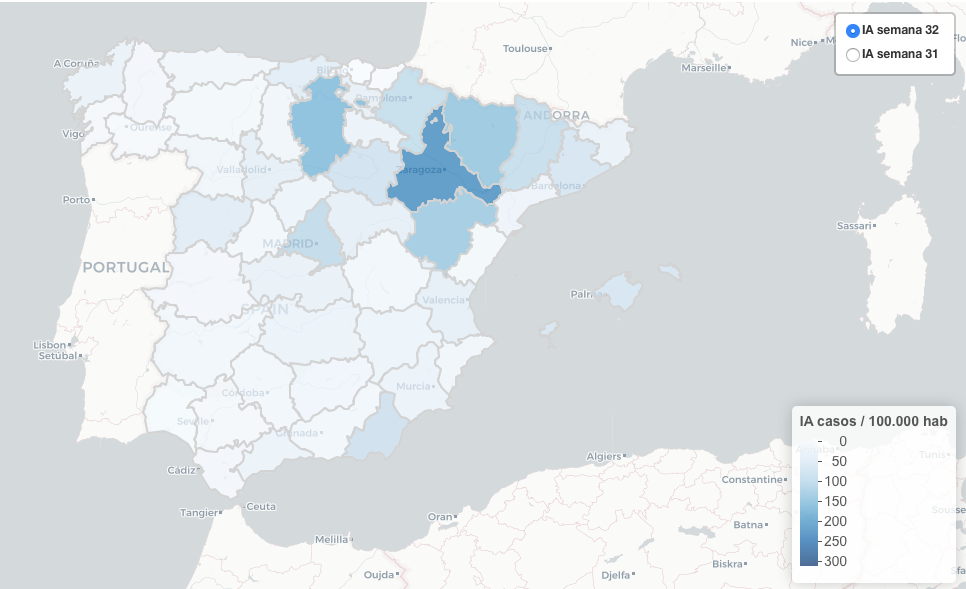
Contrary to popular belief, the situation in Spain is not as alarming as the media make it out to be. Indeed, taking a closer look at the figures, only the Province of Zaragoza is genuinely affected. The other regions are, for their part, safe as shown by this map, published by the Spanish Ministry of Health and updated daily. For each region, the map lists the number of Covid cases per 100,000 inhabitants. The data on the map below was collected during week 32, i.e. from 3 to 9 August. All coastal areas have fewer than 50 cases per 100,000 inhabitants, which is far fewer than in Belgium! For your information, here are a few figures for the Provinces of Alicante, Malaga and Murcia:
- Alicante : 16 cases per 100,000 inhabitants
- Murcia : 27 cases per 100,000 inhabitants
- Malaga : 27 cases per 100,000 inhabitants
As you will have gathered, there will be no need to postpone your holiday in the sun this summer 🙂
Final preparations before you set off!
This summer is all about safety. Specific measures have been put in place by each country to better control the comings and goings of travellers. To prepare your trip with complete peace of mind, nothing could be simpler! Just follow the 4 steps listed below.
Step 1: get informed thanks to the FPS Foreign Affairs
Every day, the Ministry of Foreign Affairs updates its colour codes to inform travellers. In the case that concerns us here, Spain appears in green. Good news, then! However, the country does have orange zones. These orange zones are accessible to travellers, so you can make the most of your holiday under the Spanish sun. That said, before you pack your bags, check the trend for the area you are visiting one last time.
For more information, head to the Ministry of Foreign Affairs portal.
Step 2: register on Travellers Online
The Travellers Online website lets you register your trip easily and free of charge.
Why register?
In the event of an incident in the country visited, the FPS Foreign Affairs will be able to inform you more easily and provide you with support. Good to know: the data entered remains strictly confidential.
How does it work?
- Create an account on Travellers Online
- Fill in your trip details: country, departure and return dates, individual or group travel, etc.
- Choose a contact person, if necessary
- Fill in your travel insurance details (optional)
Step 3: register on Spain Travel Health
The Spanish Government has introduced health screening of passengers as soon as they arrive in Spain. In practical terms, if you are preparing a trip to the Iberian Peninsula, you must complete a Health Control Form (HCF), available online or via the Spain Travel Health app, available on the App Store and the Play Store.
How to do it?
- Before the trip: complete the form (online or via the app) 48 hours before the flight. Once the form has been submitted, you will receive an email containing a QR code that will allow you to access the destination airport. You must bring this code either printed out or on your mobile phone.
- At the airport : show the QR code at the checkpoint in order to access the terminal and collect your luggage.
For more information, visit the Spain Travel Health website.
We also recommend watching this video, which sums up everything you need to know about travel to Spain.
Step 4: don't forget the Passenger Locator Form
For any trip to Belgium or return to Belgium (after a stay abroad) of more than 48 hours, the Passenger Locator Form must be completed, whatever the means of transport used.
This form can be filled in and submitted two days before departure, or a few hours before returning to Belgium. Once the form has been completed, you will receive a QR code by email. This QR code is proof that you have indeed completed the form. For returns by air, travellers will need to show this QR code when boarding. If you fail to do so, you will not be able to board.