

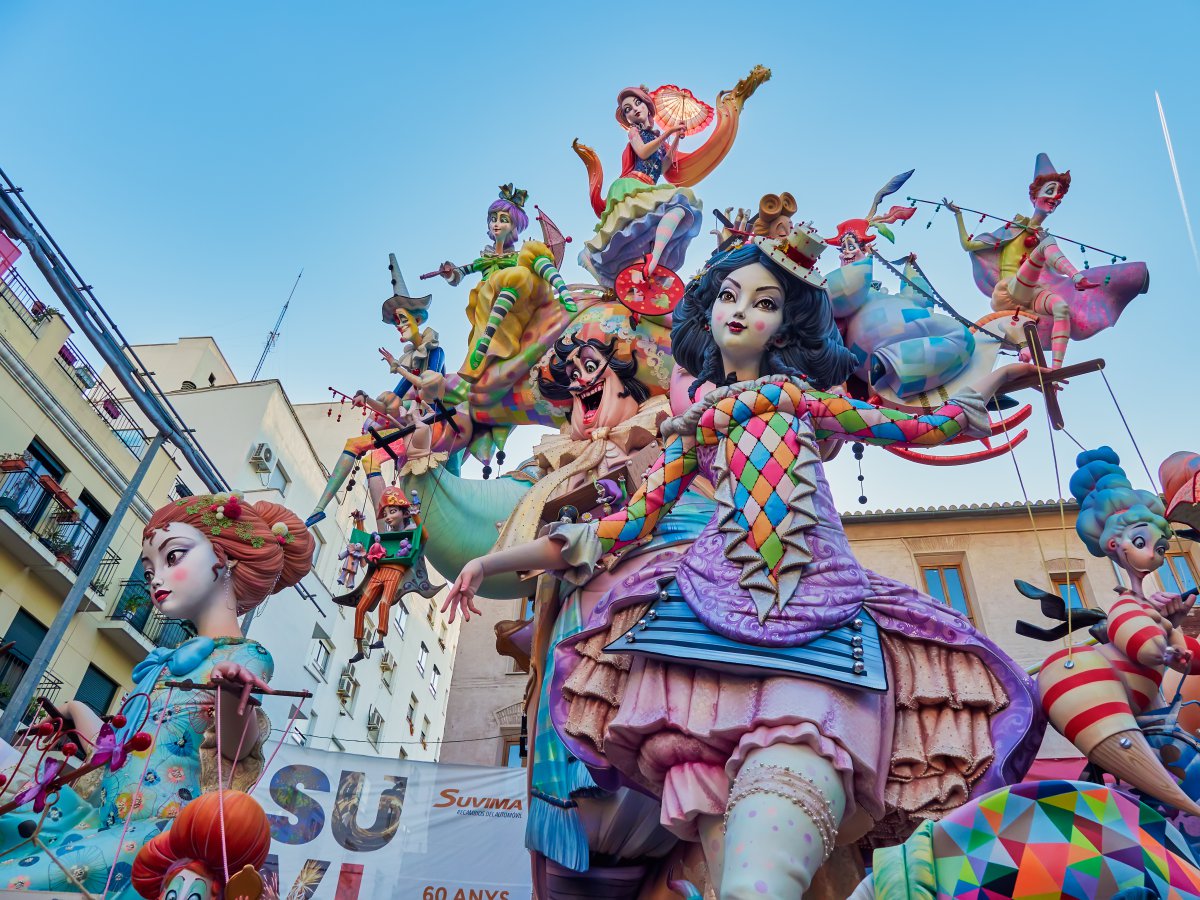
Las Fallas, the 2021 edition, is already over!
The Spanish had been eagerly awaiting it! Deprived of Las Fallas in 2020 because of the health crisis, the people of Valencia were finally able to reconnect with this traditional festival! Usually celebrated between 15 and 19 March, the 2021 edition took place from 1 to 5 September.
In this article, Secundo takes a look back at Las Fallas, inscribed on the Representative List of the Intangible Cultural Heritage of Humanity by Unesco.
The origins of Las Fallas
This festival, said to date back to the Middle Ages, takes its name from “facula”, which means “little torch” in Latin. This is because, at that time, the carpenters would burn the wooden support used to hang their torch during the winter. They also added all the pieces of wood and fabric they no longer wanted, thereby celebrating the end of winter and the arrival of spring. Over the years, old clothes were placed on the supports. The idea of imagining characters in these great bonfires began to emerge.
As time went by, the features of the characters were increasingly exaggerated to turn them ultimately into satirical representations. This is how, in the 18th century, the tradition of carpenters creating “Fallas” and burning them on the day of Saint Joseph, their patron saint, was born. This event takes place throughout the city of Valencia, but also in the surrounding villages.
The Fallas
The Fallas are satirical representations of people or events that marked the past year, in Spain or around the world.
Originally built from wood, they are now made of composite materials and are held up by a large wooden support, recalling the support that used to be burned in the old days.
The “Fallas” can measure up to 30 metres high and are made up of dozens of different characters. These figurines are called “ninots”, which means “dolls” in Valencian.
On the evening of 19 March, all these representations are burned at the spot in the city where they were set up to be displayed. This moment is called the “Cremà”.
From 1885 onwards, a “Fallas” competition was set up to designate the most beautiful and the most original, among the 760 on display.
Each “Falla” comes with a booklet in which a satirical poem, in Valencian, is written, explaining the work.
The Casales Falleros
These representations are created by the “Falleros”, groups of neighbours and friends from the same district. Even today they are made up of carpenters, joiners and cabinetmakers who work solely on this project.
Throughout the year, they gather in “Casales”, meeting places, in order to prepare their parade.
Each “Casal” appoints a “Fallera Major”, who is a woman, to represent them. She is also the one who will choose a figurine from her “Falla”, which will not be burned along with all the others. This figurine will indeed be displayed at the Museum of the Ninots.
The following year, a “Fallera Major” is elected to represent the whole city of Valencia, for one year.
A full programme
In addition to the “Fallas”, other activities round out the festival.
First of all, every day at 2 pm there is a great pyrotechnic show in the Town Hall square. This is called the “Mascletà”.
Moreover, on the second-to-last night of the “Fallas” there is an enormous firework display called “la Nit de Foc”, that is to say “the night of fire”.
There is also the tradition of “las Ofrendas”. All the “Falleros” parade solemnly, for two days, to the “Plaza de la Virgen”, where a gigantic wooden Virgin is set up, the “Virgen de los Desamparados”. More than 100,000 “Falleros”, in traditional dress, come to lay carnations there. Little by little, the Virgin is dressed in a great cloak of flowers, red, white and pink. Patterns are formed with the flowers and change from year to year.
Finally, throughout the festivities, fairground stalls are set up all over the city so that you can enjoy churros, buñuelos and other Spanish specialities.
Concerts are held here and there as well and everyone is happy to dance!
And what about you, do you know Las Fallas ? Have you ever taken part?